
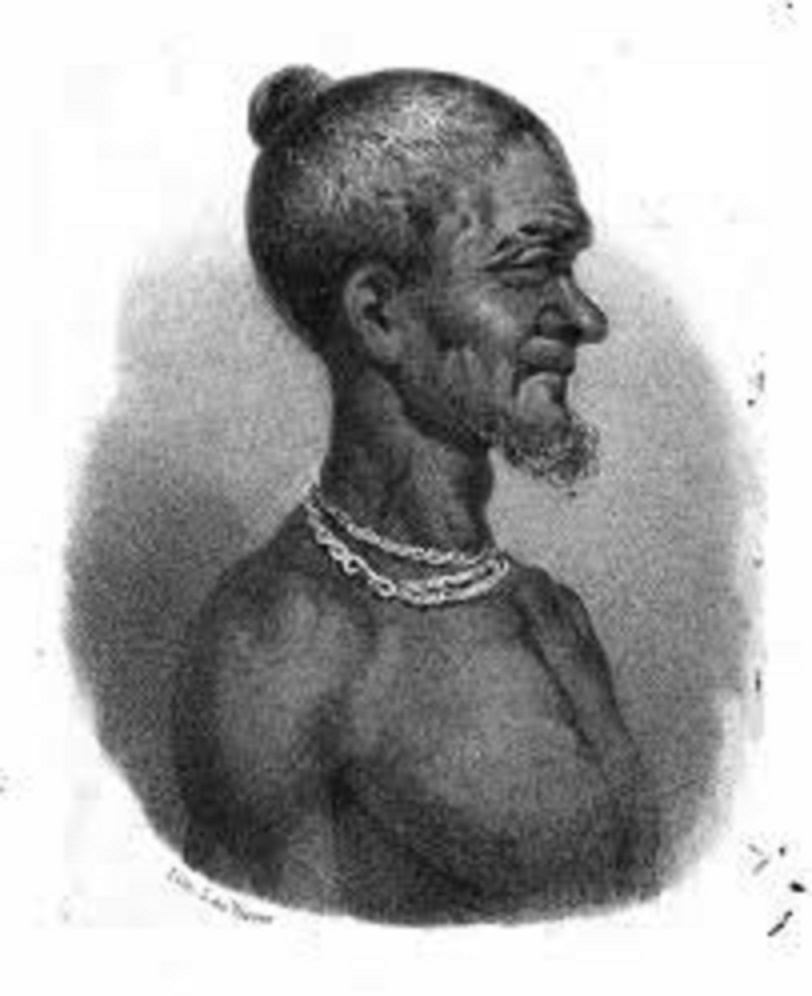
Fort Batenstein. A last drawing by a Dutch of King Badu Bonsu II, before his execution at the fort
By the early 19th century, the Ahanta were no strangers to the outside world. For centuries, European powers—first the Portuguese, then the Dutch, the Danes, and the British—had fought to control the coast’s trade routes. The Ahanta, with their strategic location and rich resources, became both coveted allies and stubborn obstacles in these imperial contests. Yet, through it all, they remained fiercely independent, guided by a network of chiefs and elders who answered to their paramount ruler—the Ahantahene.
The Ahanta were part of the larger Akan-speaking peoples of West Africa, connected by shared linguistic roots, kinship structures, and belief systems. They were skilled farmers and traders, known for cultivating palm and cocoa long before colonial plantations transformed the landscape. Their society was organized around matrilineal clans, where lineage and inheritance passed through the mother’s line. Authority flowed from family heads to village chiefs and, ultimately, to the Ahantahene—whose legitimacy rested on both ancestry and wisdom.
The Ahanta religion, like much of Akan spirituality, revolved around the worship of ancestors and reverence for nature spirits. The gods resided in rivers, forests, and stones, and the ancestors—known as nsamanfo—served as guardians of justice and continuity. Festivals, libations, and storytelling preserved the kingdom’s values, reminding each generation of their duty to the community and the land.
By the 18th century, however, the Ahanta found themselves in an increasingly dangerous position. The Dutch, who had built Fort Batenstein at Butre in 1656, had once maintained a relationship based on mutual benefit. But as Dutch commercial interests grew, cooperation gave way to domination. Treaties that were originally symbolic—such as the 1656 Treaty of Butre, which recognized Dutch protection over Ahanta—were later interpreted as instruments of control.
By the time Badu Bonsu II was born in the early 19th century, the Ahanta world was changing rapidly.
Badu Bonsu II’s exact date of birth is lost to time, as is much of his early life, but oral tradition remembers him as a man of mixed Ahanta and Fante heritage—a lineage that gave him both local legitimacy and wider connections across the Gold Coast. He was raised in a period of transformation, when traditional authority was being tested by European influence and internal rivalries.
As a young man, Badu Bonsu was known for his intelligence, charisma, and sharp understanding of both African and European politics. He spoke several local languages and was familiar with the customs of trade and diplomacy that governed coastal relations. When he rose to the Ahanta throne, he inherited not only a proud people but also a kingdom under growing pressure from the Dutch colonial administration headquartered in Elmina.
By the 1820s and 1830s, the Dutch had entrenched themselves as the dominant European force on the western Gold Coast. Their forts at Elmina, Axim, and Butre were fortified centers of commerce and military power. The Dutch West India Company, though officially dissolved in 1792, had left behind a bureaucracy that continued to enforce its economic ambitions under the Dutch crown.
For the Ahanta, the Dutch presence was a double-edged sword. Trade brought cloth, guns, salt, and spirits in exchange for palm oil, gold, and agricultural produce. But every transaction deepened dependency. The Dutch increasingly imposed trade monopolies, fixed prices, and demanded exclusive rights over Ahanta land. Chiefs who resisted were threatened, bribed, or removed. The Dutch also manipulated rivalries among local leaders, ensuring that internal division weakened any potential unity.
King Badu Bonsu II, ascending to power amid this tension, sought to restore Ahanta sovereignty. His reign was marked by an insistence that the Dutch recognize him as an equal partner, not a subordinate. He resisted foreign interference in local governance and refused to allow the Dutch to dictate who could serve as chiefs under him.
This stance earned him both admiration and enemies. Some local leaders saw his defiance as courageous, others as reckless. But for Badu Bonsu II, the issue was not personal pride—it was the principle of self-determination.
The years leading up to 1837 were fraught with incidents that eroded trust between the Ahanta and the Dutch. Disputes over taxation, land, and trade became flashpoints. The Dutch accused Badu Bonsu II of obstructing their authority; the Ahanta accused the Dutch of deceit and coercion.
Matters escalated when Dutch officials began arresting and executing Ahanta leaders suspected of disloyalty. These acts inflamed resentment across the kingdom. Badu Bonsu II viewed them as an attack on his sovereignty.
By 1836, tensions had reached their breaking point. When Dutch Governor Hendrik Tonneboeijer and Major Cremer attempted to enforce new colonial directives in Ahanta territory—possibly including the forced removal of certain chiefs—Badu Bonsu II decided that negotiation had failed. His patience, like that of his people, had run out.
To understand Badu Bonsu II’s rebellion, one must understand what was at stake. For the Ahanta, this was not merely about taxes or trade—it was about freedom, dignity, and survival. They had seen neighboring peoples subdued, their chiefs turned into figureheads, their lands divided by colonial decree.
Badu Bonsu II’s decision to resist was both political and spiritual. To submit to the Dutch would mean betraying the ancestors who had defended Ahanta land for generations. To fight, even against overwhelming odds, was to affirm the soul of the nation.
Thus, when Dutch troops marched into Busua in 1837 to enforce their rule, Badu Bonsu II struck first. What followed—the deaths of Dutch officials, the bombardment of Busua, and the brutal suppression of the Ahanta Kingdom—was the tragic climax of a long and inevitable confrontation.
Before his rebellion, Badu Bonsu II was remembered as a just and eloquent ruler—a man who walked among his people, settled disputes, and upheld the moral codes of Ahanta law. Oral histories describe him as stern but fair, a king who believed deeply in the unity of his people.
He was also a reformer in his own right, encouraging trade that benefited the Ahanta and limiting Dutch interference in local markets. His leadership gave the Ahanta a rare period of relative stability in an era of chaos.
Yet, in the end, his refusal to compromise on independence sealed his fate. The Dutch could not tolerate a sovereign African ruler defying their authority. His capture and execution in 1838 were not just acts of vengeance—they were meant as a warning to all African leaders who might dream of freedom.
Even after the fall of their king, the Ahanta people endured. They rebuilt their towns, revived their traditions, and kept alive the stories of their ancestors. Through oral history, song, and ritual, they preserved the memory of Badu Bonsu II—the king who defied the empire.
Today, his story stands not as a tale of defeat, but of courage. It reminds us that the struggle for autonomy did not begin with modern nationalism—it was born in villages like Busua and Butre, in the hearts of people who refused to surrender their destiny.
Before the rebellion, before the execution, there was a king who believed his people deserved to stand unbroken.
This was the world of Badu Bonsu II—the last great sovereign of the Ahanta before the empire’s shadow fell across their shores.
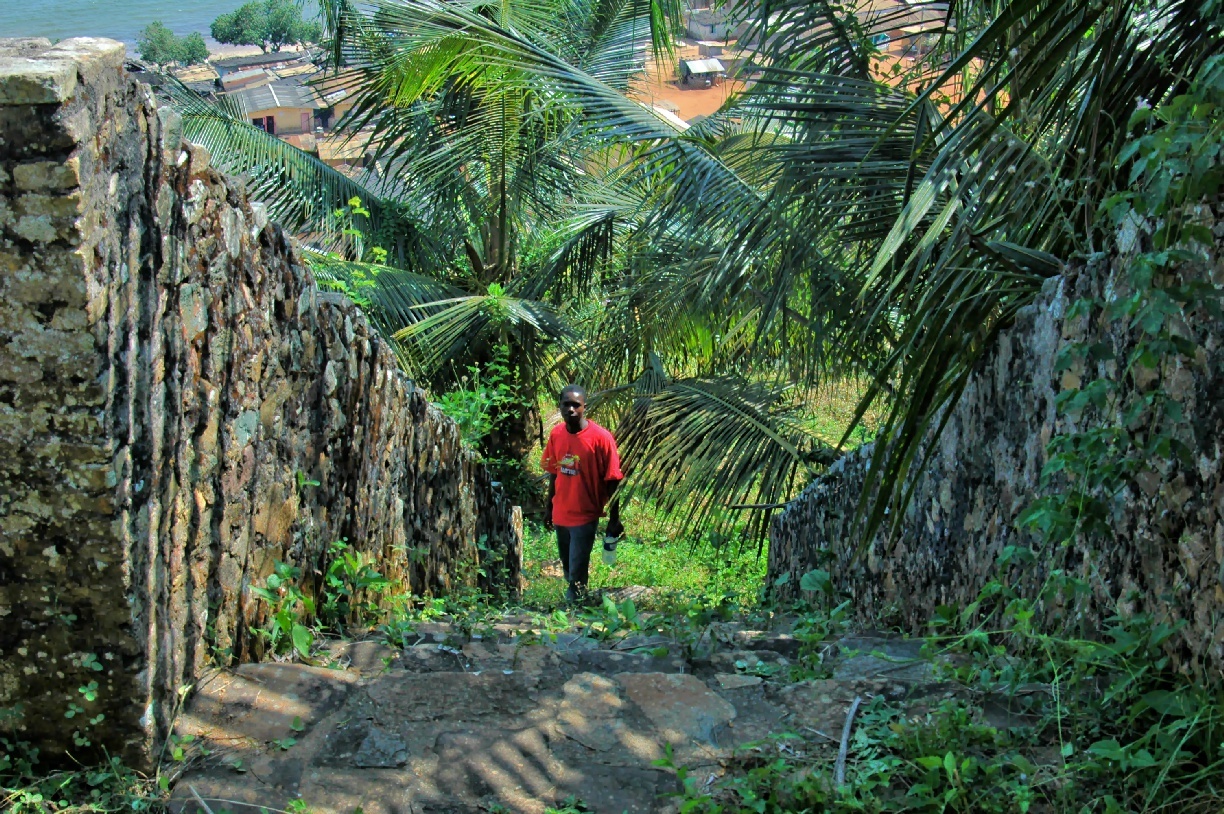
Entrance of walk way up to Fort Batenstein! This are the very stairs King Badu Bonsu II had to climb up before the Dutch executed him! (c) Remo Kurka